Multi-Channel vs. Omni-Channel
In the contemporary digital landscape, the customer journey is no longer a linear progression but a complex, multi-dimensional tapestry woven across numerous touchpoints. Empirical data consistently reveals that modern consumers engage with an average of 6 to 10 distinct channels before culminating in a purchase decision. This profound shift necessitates a strategic evolution from siloed, channel-specific engagements to a harmonized, integrated customer experience. To only play on one channel, or even multiple disconnected channels, is to fundamentally misunderstand the modern buyer's expectations and, inevitably, to lose market share to competitors who grasp the imperative of true omnipresence. This deep dive will dissect the architectural and operational blueprint required to achieve **The Perfect Omni-Channel Mix**, enabling enterprises to truly **Be Everywhere Without Going Crazy**.
The pervasive misconception equating mere multi-channel presence with an omni-channel strategy often leads to fragmented customer experiences and suboptimal business outcomes. Many organizations, in their earnest attempt to **Be Everywhere**, inadvertently create a cacophony of disconnected interactions. Consider a scenario where a prospective customer interacts with a Facebook Ad campaign, subsequently engages with an email sequence, and later visits the corporate website. If the underlying data infrastructure lacks true integration, the Facebook Ad platform operates in isolation from the Email Service Provider (ESP), and the website's content management system (CMS) or e-commerce platform remains oblivious to prior interactions. The result is a jarring, inconsistent experience: redundant advertisements for products already viewed, irrelevant email promotions following a recent purchase, or a website failing to recognize a returning visitor's context. This fragmentation doesn't merely annoy customers; it actively erodes brand trust, diminishes customer lifetime value (CLTV), and inflates customer acquisition costs (CAC) through inefficient targeting and wasted marketing spend. The foundational premise of omni-channel is not simply being present across various channels, but orchestrating a single, fluid conversation that adapts and evolves with the customer's journey, irrespective of the chosen touchpoint.
Achieving this fluid conversation demands a sophisticated technical architecture designed to unify customer data and orchestrate interactions in real-time. The primary technical challenge lies in overcoming the endemic issue of data silos. Enterprises typically operate with a disparate array of systems: Customer Relationship Management (CRM) for sales and service interactions, Marketing Automation Platforms (MAP) for campaign execution, Enterprise Resource Planning (ERP) for order fulfillment and inventory, dedicated e-commerce platforms, customer support ticketing systems, and various analytics tools. Each system, while optimized for its specific function, often maintains its own proprietary customer data schema and operational logic, resulting in fragmented customer profiles. Without a centralized, canonical view of the customer, it becomes technically impossible to maintain context across channels. This is precisely why a Facebook Ad might target a customer who has already converted via an email campaign – the advertising platform simply doesn't possess real-time, unified intelligence from the ESP or the e-commerce system.
The cornerstone of **The Perfect Omni-Channel Mix** is the establishment of a robust Customer Data Platform (CDP). Unlike traditional data warehouses or CRM systems, a CDP is specifically engineered to ingest, unify, normalize, and activate customer data from all sources, both online and offline. Technically, a CDP employs advanced identity resolution algorithms to stitch together disparate data points (e.g., email addresses, device IDs, loyalty program numbers, IP addresses) into a single, persistent, 360-degree customer profile, often referred to as the "golden record." This involves sophisticated data ingestion pipelines, leveraging APIs, webhooks, and batch processing to ensure comprehensive data collection. Once unified, the CDP provides a centralized repository for customer attributes, behaviors, and preferences, making this intelligence accessible to all downstream activation systems. This technical foundation is critical for enabling personalized experiences, as it ensures that every system interacting with the customer operates from the same, most current understanding of their journey.
Furthermore, true omnipresence mandates real-time data synchronization and event-driven architectures. A customer's action on one channel – be it adding an item to a cart on a mobile app, submitting a support ticket, or clicking a link in an email – must instantaneously update their unified profile and trigger appropriate responses across *all* relevant channels. This is achieved through message queuing systems (e.g., Apache Kafka, RabbitMQ) and event streaming platforms that publish and subscribe to customer interaction events. For instance, a customer viewing a specific product page on the website might trigger an event that instantly updates their segment in the CDP, which then informs the advertising platform to serve a retargeting ad for that exact product, while simultaneously alerting the sales team via the CRM if the customer meets specific lead scoring criteria. This level of responsiveness is what transforms a multi-channel presence into a coherent, fluid omni-channel conversation, effectively allowing businesses to **Be Everywhere Without Going Crazy** by automating contextual relevance.
An API-first strategy is another non-negotiable technical imperative. Modern omni-channel platforms are not monolithic applications but rather ecosystems of interconnected services. Exposing robust, well-documented APIs allows for seamless integration between the CDP, CRM, MAP, e-commerce, customer service platforms, and emerging channels. This microservices-oriented approach enhances agility, scalability, and the ability to rapidly integrate new technologies or adapt to evolving customer behaviors. It mitigates the risk of vendor lock-in and facilitates the creation of custom integrations tailored to unique business processes, ensuring that data flows freely and intelligently across the entire customer experience ecosystem.
The ultimate objective of **The Perfect Omni-Channel Mix** is to operationalize "a single, fluid conversation" through contextual intelligence and predictive analytics. With a unified customer profile and real-time data streams, businesses can leverage machine learning (ML) and artificial intelligence (AI) to move beyond reactive responses to proactive engagement. ML algorithms can analyze historical data to predict future customer needs, identify potential churn risks, and recommend the "next best action" for each individual. This enables dynamic content delivery, personalized product recommendations, and optimized outreach timing across email, SMS, push notifications, and even outbound sales calls. Advanced attribution modeling, powered by the integrated data, provides a clearer understanding of the true ROI of each touchpoint, moving beyond last-click biases to accurately credit the complex interplay of channels that contribute to conversion.
Navigating the complexities of implementing such an intricate architecture requires a strategic approach to avoid "going crazy." This isn't a "big bang" project but rather a phased implementation focusing on incremental value delivery. Prioritizing key customer journeys and implementing omni-channel capabilities for those first allows for iterative learning and optimization. Scalability and performance must be designed into the system from day one, anticipating future data volumes and interaction complexity. Furthermore, robust data governance frameworks, encompassing data quality, privacy (e.g., GDPR, CCPA compliance), and security, are paramount to maintaining customer trust and regulatory adherence. The investment in talent, infrastructure, and ongoing maintenance for such a sophisticated ecosystem is substantial, necessitating clear, measurable KPIs to demonstrate ROI and secure sustained executive buy-in.
In conclusion, the journey to **The Perfect Omni-Channel Mix** is not merely about expanding presence but about intelligent, integrated orchestration. It requires a profound technical commitment to dismantling data silos, unifying customer intelligence, and activating real-time insights across every touchpoint. By embracing a CDP-centric architecture, real-time event processing, and an API-first strategy, enterprises can transcend the limitations of fragmented multi-channel efforts. This blueprint for true omnipresence empowers organizations to deliver a consistent, personalized, and highly relevant customer experience, ensuring they can effectively **Be Everywhere Without Going Crazy** – a strategic imperative for sustained competitive advantage in the modern digital economy.
Multi-Channel (Chaotic)
- ✓Channels in silos (separated)
- ✓Contradictory messages
- ✓Data is scattered
- ✓Customer is confused
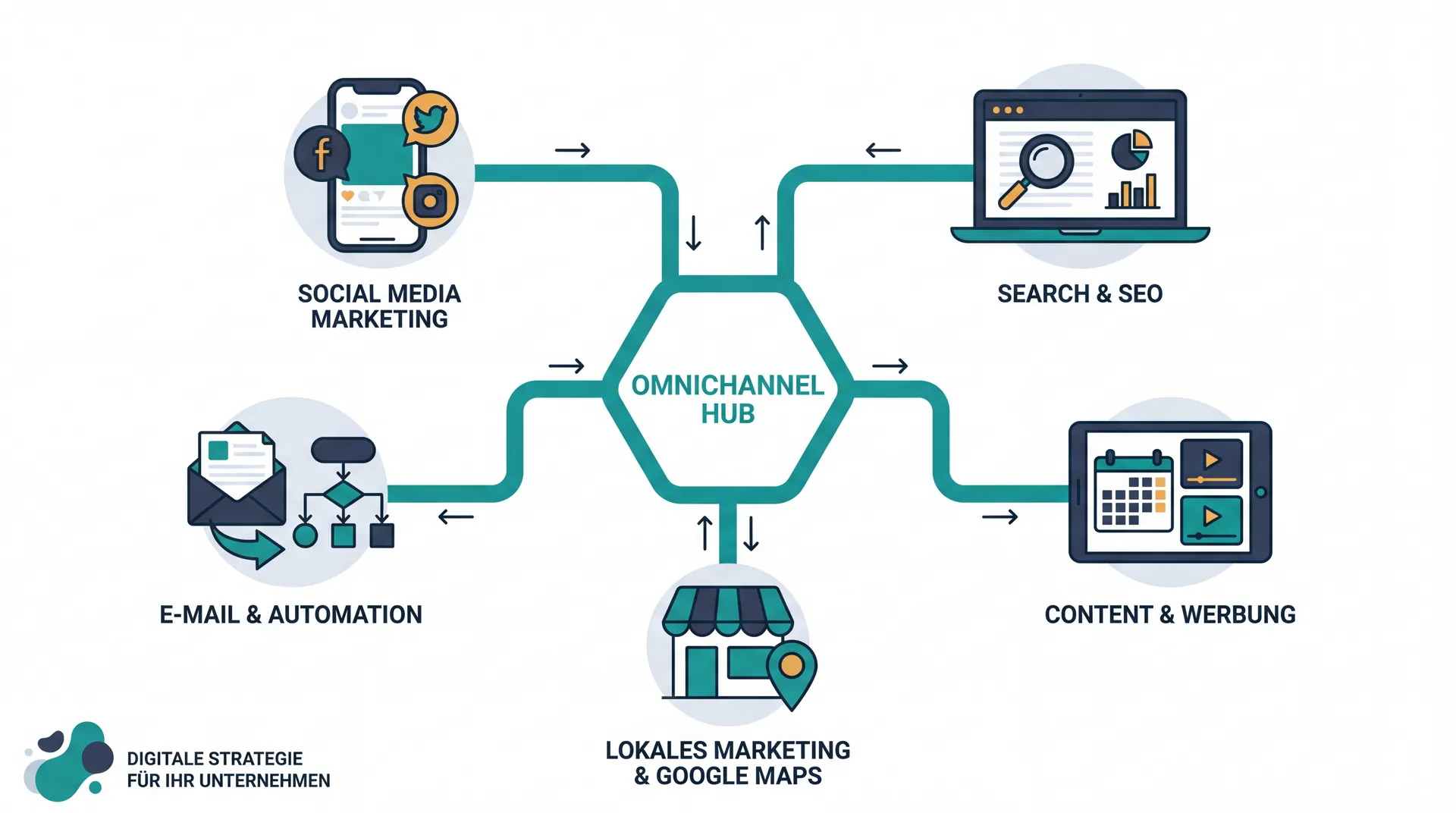
Omni-Channel (Integrated)
- ✓Central Customer Database (CDP)
- ✓Consistent Story
- ✓Real-Time Data Sync
- ✓Seamless Experience
The 7 Must-Have Touchpoints
The Orchestration
Imagine you are a conductor. Your channels are the instruments. If everyone plays what they want, it's noise. If everyone plays by the notes, it's music. We use tools like Klaviyo, HubSpot, and Custom Dashboards to conduct this symphony.
Bring Order to Chaos
We develop your Omni-Channel Blueprint in a half-day workshop.