The End of 'Guesswork Marketing'
Henry Ford's lament – "I know at least half of my advertising budget is wasted. I just don't know which half." – articulated a pervasive challenge of early 20th-century commerce. While a quaint admission in 1920, to utter such a statement in the current digital epoch, circa 2024, is not merely an anecdote; it represents a fundamental failure of strategic insight and operational efficiency, bordering on an admission of impending fiscal distress. In an increasingly complex, hyper-connected, and data-saturated global economy, where every micro-interaction, every user journey, and every transactional touchpoint generates measurable data, ignorance is not a limitation—it is a deliberate, costly choice.
Despite the ubiquitous availability of sophisticated analytics platforms and Business Intelligence (BI) tools, a significant proportion of enterprises, ranging from agile startups to established multinational corporations, continue to predicate critical business decisions on subjective intuition. This phenomenon is frequently encapsulated by the "HiPPO" principle: the **Hi**ghest **P**aid **P**erson's **O**pinion. Whether it's the CEO "feeling" that a particular market segment is ripe for disruption, the CMO "believing" a new creative campaign will resonate better than its predecessor, or the Head of Product "assuming" a certain feature iteration will enhance user engagement, these decisions are often divorced from empirical evidence. Such reliance on anecdotal experience, personal biases, or perceived industry wisdom, rather than rigorously analyzed data, constitutes a critical vulnerability in modern business operations. This is precisely **why your gut feeling costs you millions**.
Consider the intricate landscape of modern marketing attribution. In a multi-channel, multi-device customer journey, a prospect might encounter a brand through a programmatic display ad, then a social media post, followed by an organic search result, and finally convert via an email link. Assigning credit for this conversion based on a "gut feeling" is not only inaccurate but actively detrimental. Without a robust data model – leveraging sophisticated attribution models like time decay, position-based, or even custom algorithmic models – marketing budgets are misallocated. An intuitive assumption might overvalue the last-click channel, leading to excessive investment in downstream tactics while neglecting crucial upstream awareness drivers. This blind allocation results in suboptimal Cost Per Acquisition (CPA), diminished Return on Ad Spend (ROAS), and a squandering of valuable capital that could otherwise fuel profitable growth. In essence, **Data Doesn't Lie** when it meticulously maps the true influence of each touchpoint; intuition, however, often paints a distorted picture.
Beyond marketing, the HiPPO effect permeates product development. A product manager's "hunch" about a desired feature or a UI/UX tweak, if not validated through A/B testing, user behavior analytics, and quantitative feedback loops, can lead to significant resource drain. Engineering hours, design cycles, and deployment costs are sunk into initiatives that may not resonate with the target audience, failing to improve key metrics like retention, engagement, or conversion. The opportunity cost of developing an unvalidated feature is equally staggering: resources diverted from genuinely impactful innovations, delayed time-to-market for competitive offerings, and a widening gap between product vision and market reality. Each such misstep, fueled by an unverified "gut feeling," compounds into substantial financial losses, directly illustrating **why your gut feeling costs you millions** in wasted R&D and lost market share.
Operational inefficiencies, too, are fertile ground for intuitive decision-making to exact a heavy toll. Supply chain management, for instance, requires precise forecasting, inventory optimization, and logistics planning. A manager's "feeling" about impending demand surges or supply disruptions, unbacked by predictive analytics leveraging historical sales data, macroeconomic indicators, and real-time sensor data, can lead to either costly overstocking or crippling stockouts. Both scenarios translate directly into millions lost through carrying costs, obsolescence, expedited shipping fees, or forfeited sales. Similarly, in sales operations, a leader's "belief" about which leads are "hotter" or which territories possess greater untapped potential, without the backing of lead scoring models, propensity-to-buy analytics, or geo-spatial market analysis, results in misdirected sales efforts, lower conversion rates, and a suboptimal utilization of a highly compensated sales force. In these critical areas, **Data Doesn't Lie**; it objectively reveals bottlenecks, predicts trends, and illuminates the most efficient path forward.
The cumulative effect of these subjective decisions is not merely incremental; it's exponential. A few percentage points lost on marketing ROI, coupled with a slightly inefficient product roadmap and marginally suboptimal operational flows, quickly escalates into a multi-million-dollar deficit on the balance sheet. This isn't theoretical; it's the tangible cost of operating in the dark when the tools for illumination are readily available. The competitive landscape is unforgiving; competitors leveraging advanced analytics to optimize every facet of their business gain a decisive edge, eroding market share from those clinging to antiquated, intuition-based methodologies.
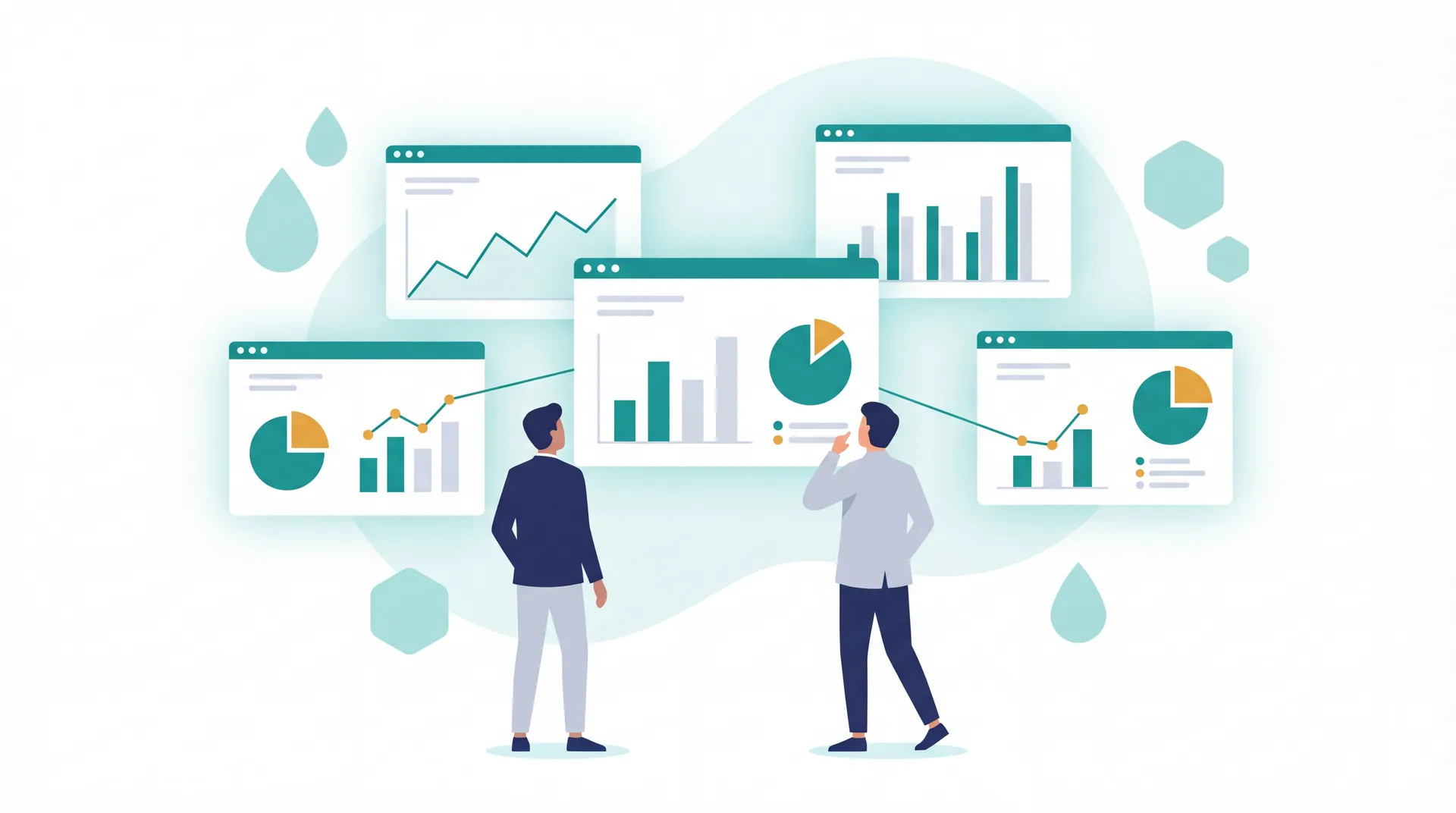
In this context, Business Intelligence (BI) emerges not as a luxury, but as an existential imperative. BI platforms, encompassing data warehousing, ETL processes, advanced analytics engines, and intuitive visualization dashboards, transform raw, disparate data into actionable insights. They provide the objective truth that **Data Doesn't Lie**, offering a clear, unambiguous view of performance, opportunities, and risks. By replacing "gut feelings" with empirically validated insights, organizations can precisely attribute marketing spend, optimize product features based on user behavior, streamline operational processes, and forecast with greater accuracy. This shift from subjective conjecture to objective evidence is the fundamental difference between merely surviving and truly thriving in the modern economy, safeguarding against the immense financial drain that continues to plague enterprises that fail to grasp **why your gut feeling costs you millions**.
"Without data, you're just another person with an opinion."
Where Do You Really Stand?
Before we dive deep into tech, let's be honest. Most companies massively overestimate their data competence. They installed Google Analytics and think they are 'Data Driven'. That's like owning a thermometer and thinking you're a doctor.
Take the honest self-check now. Where do you stand on the evolutionary ladder of Business Intelligence?
The 4 Dimensions of Data Maturity
Business Intelligence isn't software you buy. It's a process. A maturity model. Most companies are stuck in Level 1 or 2. Market leaders operate in Level 4.
The Compound Effect in Marketing
Why is Level 4 so important? Because of the compound interest effect. Those who optimize manually (Level 1-2) are slow. Those who optimize automatically (Level 4) get a little bit better every day.
1% improvement per day means a 37x increase after a year. See the difference:
The green curve is the result of feedback loops. Every dedicated dollar generates data. This data improves the algorithm. The improved algorithm makes the next dollar more efficient. It is a flywheel that, once set in motion, is hard to stop.
The Technical Foundation (Modern Data Stack)
How do you build this? Not with Excel. A Modern Data Stack for 2026 looks like this:
1. **Collection Layer:** Server-Side GTM (Google Tag Manager). Cookies are dying. We must collect data server-side to bypass Ad-Blockers and ITP (Safari). 2. **Storage Layer:** A Data Warehouse (e.g., BigQuery or Snowflake). ALL data flows together here: Website, CRM, Ad Platforms, Finance Tools. 3. **Transformation Layer:** Tools like dbt clean and link the data. 4. **Visualization Layer:** Looker Studio or PowerBI for dashboards everyone understands. 5. **Activation Layer:** Reverse-ETL sends *insights* back to Facebook/Google ('This customer has high CLV, find more people like them').
Audit: Is Your Tracking Ready for 2026?
Traditional Reporting
- ✓Monthly PDFs
- ✓Siloed Data (Facebook vs Google)
- ✓Focus on Vanity Metrics (Likes, Clicks)
- ✓Looks only backward
Coday Intelligence
- ✓Real-Time Dashboards
- ✓Single Source of Truth
- ✓Focus on Business Metrics (Profit, CLV)
- ✓Looks forward (Forecast)
Conclusion: Become a Sniper
Marketing without data is like shooting a shotgun in the dark. You might hit something, but you waste a lot of ammo.
Business Intelligence makes you a sniper. One shot, one hit. Less budget, more results. That's not magic, that's mathematics.
End the Blind Flight
We'll audit your current tracking setup for free and show you where your data has gaps.